
Lehigh County Directory Holdings
Lehigh County has two local directory access points with different stated end dates. Allentown Public Library, or APL, keeps Allentown historical directories from 1860 through 1980 on microfilm. The Lehigh County Historical Society, or LCHS, lists Allentown directories from 1860 to current on shelf 917.482. Those statements describe holdings, not a promise that every annual issue, publisher, or page survives. Confirm the particular year against the reel, shelf, or catalog before treating it as available.
| Collection | Years | Where Held | Access |
|---|---|---|---|
| Allentown historical directory reels | 1860 to 1980 | Allentown Public Library Reference | Microfilm on public readers |
| Allentown directories, shelf 917.482 | 1860 to current | Lehigh County Historical Society | Library and archive access, subject to restrictions |
| Williams’ Allentown City and Lehigh County Directory | 1889 | University of Pennsylvania digital collection | Digitized volume |
| Boyd’s Directory | 1860 | Pennsylvania State University digital collection | Digitized regional volume |
The 1860 Boyd’s book includes Allentown in a regional directory of neighboring counties, so it is a dated checkpoint rather than proof of a complete annual local series. The precisely cataloged 1889 Williams’ volume is a separate, more detailed Allentown source. Keep its year and scope in the citation.
When the APL reel ends, check LCHS before concluding that the local print tradition stopped. The two repositories describe different holdings, and neither gives a complete publisher-by-publisher chronology or an item-level list of every annual volume. Confirm the volume title and physical condition with the repository.
Lehigh County Directory Microfilm Desk
APL’s Reference Department gives the historical shelf a practical in-person route. It has two public microfilm readers, charges $0.25 per printed page, and says a scan can be saved as PDF, JPG, or PNG, or sent by email or USB. The library is at 1210 Hamilton Street, Allentown, PA 18102, and its published telephone number is 610-820-2400. Preserve the directory year, reel, and page or image with each result, especially when a street spelling or number is important.
APL’s microfilm collection page identifies the directory, newspaper, obituary-index, and census runs available in Reference.
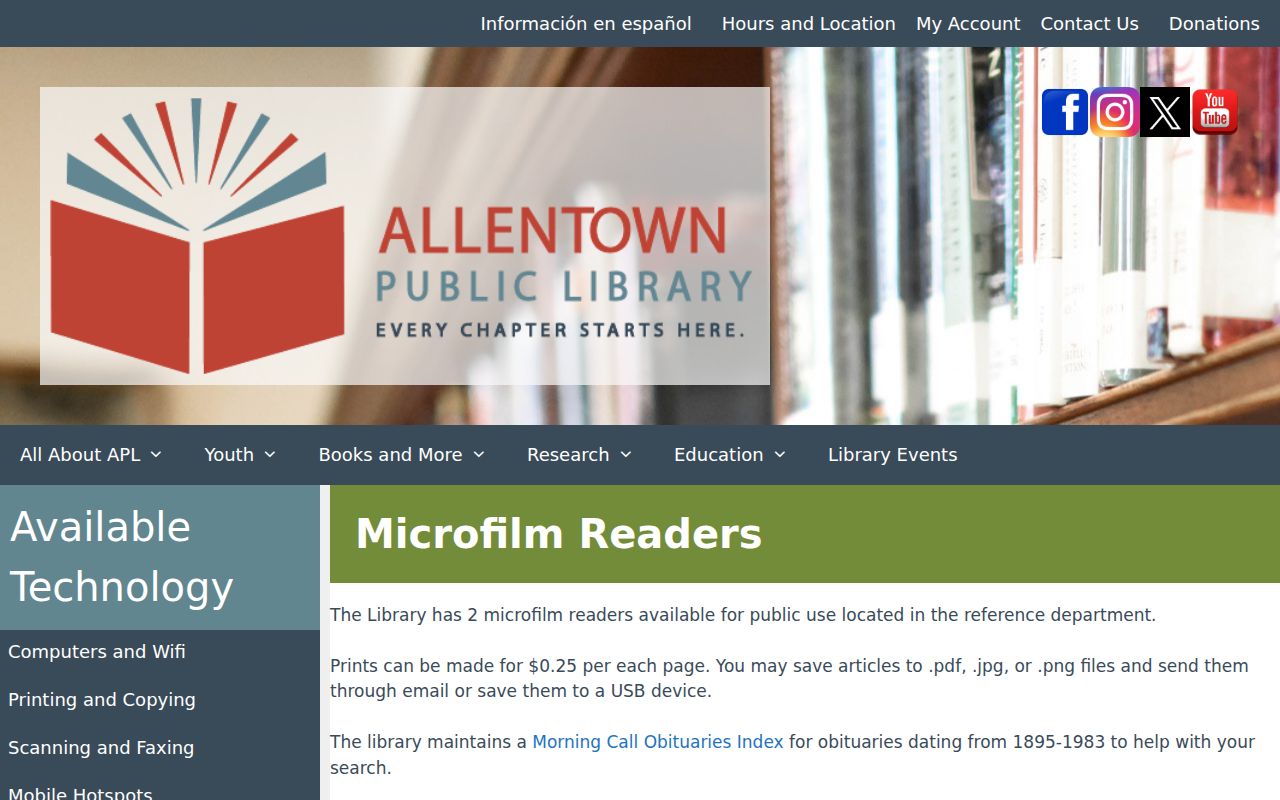
Use the reader output as a source copy, not just a memory aid. A saved image makes it possible to compare the heading, entry placement, and surrounding names with a later map or census record.
Note: APL’s stated span identifies its microfilm holding, while a missing year or page still needs a reel-level check.
Reading a Lehigh County City Directory
A directory page should be cited as a page from one dated volume, not as a loose statement about a person. The research confirms the structure of the 1889 Williams’ volume, but it does not verify the exact abbreviations or every field used by an individual entry until the relevant scan is opened. That distinction matters. Copy the page heading, spelling, street number, and any visible labels exactly, then save the volume’s abbreviation key if that issue supplies one.
| Entry heading | Record the exact surname or street heading as printed. |
|---|---|
| Street and number | The 1889 street component is cataloged as listing street, number, and occupant for each building. |
| Post-office wording | The county portion of the 1889 volume includes residents’ post-office addresses. |
| Page reference | Keep the scan page, volume title, year, and repository with the note. |
| Unverified conventions | Do not assume an abbreviation, relationship label, or other field without reading that page and its key. |
- Street directory
- A portion arranged by street rather than surname. The cataloged 1889 volume has one.
- Householder index
- A name-based arrangement used to locate a household entry. Confirm whether a given volume includes one.
- Abbreviation key
- A volume-specific explanation of shortened labels. Read it before expanding any notation in a research note.
Lehigh County Directory 1889 Volume
The University of Pennsylvania’s digitization describes the 1889 Williams’ Allentown City and Lehigh County Directory as a 416-page book published by The New Era Book and Job Print. Its catalog description names a general Allentown citizen directory, classified business directory, street directory, map, appendix, county residents’ post-office addresses, and business directories for Catasauqua, Emaus, Macungie, and Slatington. That range makes it useful for checking the form of a historical address before a repository visit.
The University of Pennsylvania’s catalog for the 1889 Williams’ directory is the source for the digitized description.
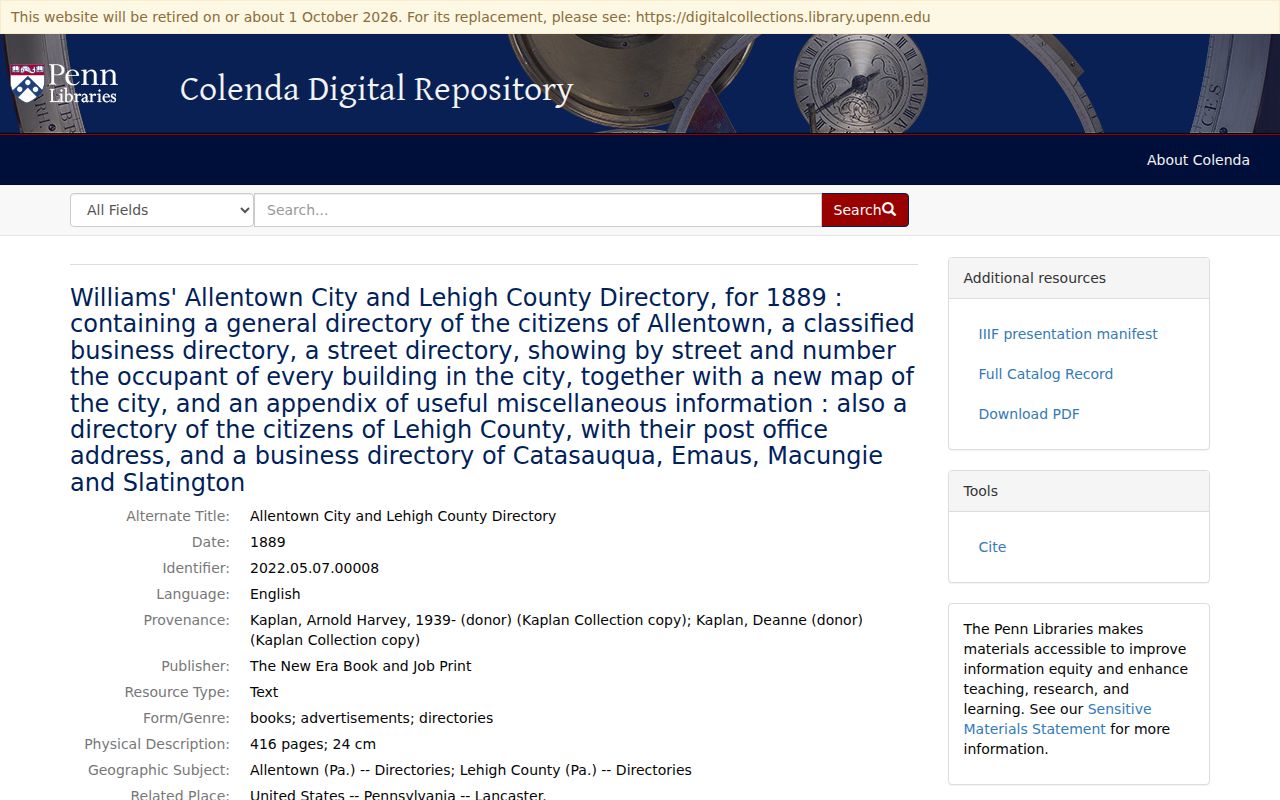
The scan is evidence for 1889 only. Compare an old street wording with the dated map or recorder description rather than converting it automatically to a present-day label.
Tracing Lehigh County Directories
Directory years can fill the long spaces between census releases, but the strongest result is a dated sequence rather than one isolated hit. APL also holds federal census microfilm from 1800 through 1930. Pair a directory entry with the nearest census year and retain both sources separately. The census can test a household grouping, while the directory can narrow a move or show a street spelling used between census years.
- Start with an exact year or narrow range suggested by a deed, newspaper, census record, or other dated source.
- Check the alphabetical portion for a surname, or the street portion when an historic number is already known.
- Record the spelling, street wording, page, and directory year exactly as printed.
- Compare that year with the closest available census reel, keeping the two citations distinct.
- Test a move against the next available directory year, a newspaper issue, or a recorder document.
A disappearance does not establish why someone left an address. It may reflect a move, a changed spelling, a coverage choice, or a gap in the holdings. Check surrounding years before drawing a conclusion.
Lehigh County Directory Newspaper Trail
APL adds a second dated source beside its directories. The Morning Call microfilm run begins in 1895, and the library’s obituary index covers 1895 through 1983. The index is a retrieval key: it gives the appearance date and page of an obituary, not the date of death. Use that page reference to retrieve the newspaper issue on microfilm, then compare the notice with the directory year and any estate or map record that fits the period.
APL’s obituary-index instructions divide the material into 1895 to 1899, decade groups from the 1900s through the 1970s, and 1980 to 1983. Record both the index result and the newspaper page, because they answer different questions.
The library directs microfilm requests to its AV desk. When the index supplies a page, ask for that issue instead of treating a surname hit as the final source. A directory entry, the retrieved newspaper page, and an estate or map record may agree, but each still keeps its own date and evidentiary limit.
Note: A newspaper appearance date is a reproducible finding aid, not a substitute for the date of death.
Lehigh County Archive Companions
LCHS extends the local shelf and adds maps, deeds, surveys, warrants, estate and court compilations, church and cemetery records, newspapers, photographs, and manuscript material. It is at 432 W. Walnut Street, Allentown, PA 18102, telephone 610-435-1074. The published library hours are Tuesday through Thursday from 10 to 4, with Friday by appointment. Fragile material can have handling restrictions, and Trexler General archive material is not digitized or available off-site.
The Lehigh County Historical Society provides the public route to its research library and archives.
Ask for the specific year, volume title, condition, and citation details. A shelf listing is a starting point, while the volume and page carry the usable evidence.
When a directory does not answer a family-history question, Lower Macungie Library offers noncirculating church and cemetery material, school yearbooks, and in-library genealogy resources. Its local-history collection is a companion source, not a replacement for the dated directory page.
Lehigh County Archive Date Checks
A directory or obituary reference can help choose a date-qualified archive route, but it does not open a recent vital record. Pennsylvania births become public at the State Archives 105 years after birth, and deaths become public 50 years after death. For an eligible archival request, the published State Archives process calls for identifying information including name, date, and certificate number, and lists a $5 noncertified copy. Marriage and divorce evidence follows different county-centered channels.
Pennsylvania’s archival birth and death request page states the noncertified-copy procedure and date gates.
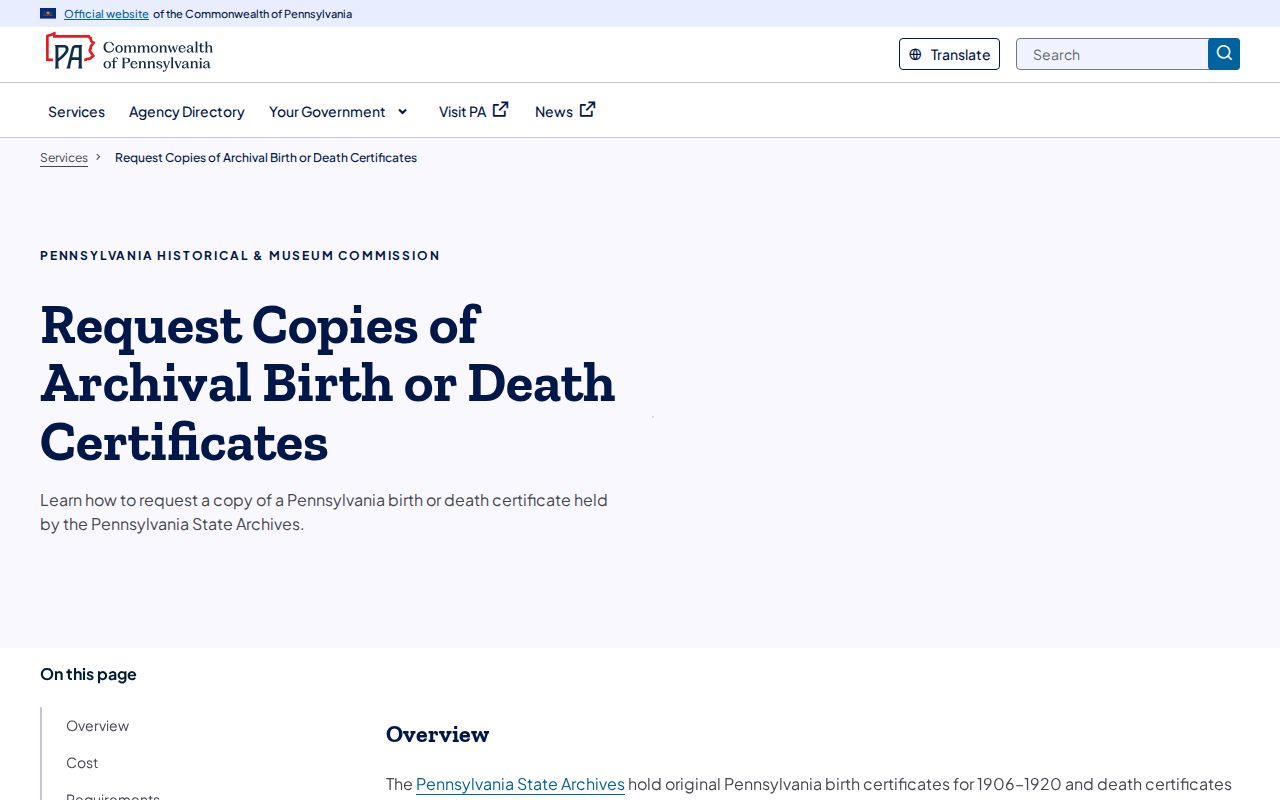
Use the archive request only after a directory, index, or other source supplies a sound date and identity trail. It is a separate custodian process, not a directory search.
Lehigh County Directory Limits
Historic directories are strongest when they stay within their date, geographic scope, and printed structure. APL’s 1860 to 1980 reel run should not be described as proof that the series ended after 1980, because LCHS lists a separate shelf through current. At the same time, neither holding page identifies every publisher or every missing volume. Check the physical item before citing a year as continuous.
Historic post-office wording is also not a modern postal code or municipal boundary. Preserve the wording used by the volume, compare it with a map and legal description of the same era, and label an unresolved match as unverified. For a modern address-keyed record trail, use the county property and recorder channels rather than treating an old historical volume as current proof.