
What a Lehigh County Resident Lookup Confirms
Different records prove different, limited facts. An assessment entry can connect an owner name to a parcel, while a court docket can place a similarly named party in a dated proceeding. A historical vital index can help separate two people with the same name, but it does not open a current certificate to the public. Use the record that fits the question, save its retrieval date, and keep conflicting results visible rather than forcing a match.
| Record | What It Confirms | Where | Access |
|---|---|---|---|
| Assessment and parcel | Owner shown by Assessment, situs, PIN, and assessment context | County PropertySearch | Public search, but not a household roster |
| Recorded deed | Grantor, grantee, recording trail, and legal-description clues | Recorder of Deeds | Index or custodian route; inspect the document |
| Court docket | Party role, docket number, events, and public case status | Pennsylvania UJS Case Search | Public docket information where available |
| Voter status | An individual registrant's status and precinct information | Pennsylvania status service | Identity-match tool, not name browsing |
| Historic vital record | A date-qualified birth or death event and archival certificate lead | Pennsylvania State Archives | Public only after statutory date gates |
| Entity or license | Organization identity or professional credential status | Department of State | Separate, purpose-specific searches |
With a street address, begin with the parcel. With a docket number, begin with UJS. With an old death date, begin at the Archives. A resident lookup should not begin by treating a generic name match as identity proof. A date, a party role, a parcel identifier, or a document number supplies the second fact needed to test that match.
Lehigh County Property Lookup Modes
PropertySearch has exactly three public search types: Address, Parcel Identification (PIN), and Document ID or Instrument Number. It does not offer a name selector. The form requires at least four characters, rejects special characters, and places a captcha between the inputs and the search button. Try the County's published street direction and suffix forms when an address does not return cleanly.
A PIN is 12 digits. County guidance allows a PIN by itself or a PIN with a one-to-five-digit PAR separated by a space or dash. Preserve both identifiers and the site address exactly as returned. An old map, block, or lot reference can be a useful historical note, but it is not a replacement for the current PIN or PAR. The free screen is also different from the County's deeper Online Records Access subscription, so an absent public result is not a conclusion about every possible county record.
Note: A property owner or assessment mailing line does not establish every resident at the situs address.
Lehigh County Court Lookup Results
The statewide UJS portal is the broad free start for a public Lehigh County docket. Its name route uses participant last name, first name, and date of birth, and County or Judicial District can narrow a statewide search. Direct docket and citation modes are separate. For civil, family, divorce, judgment, lien, marriage-license, probate, or Orphans' Court questions, Lehigh's Odyssey channels and the division holding the file are the local follow-up routes.
The County Civil Division is the local file-and-copy channel at the Lehigh County Courthouse, 455 Hamilton Street, Room 122, 610-782-3148. A public UJS docket sheet has a limited but useful result inventory:
- Case identity: court name, docket number, case type, and caption party roles.
- Calendar events: schedule status, time, room, and judge where the public record displays them.
- Entries: filing and document dates, sequence, filed-by information, service status, and event text.
- Financial page: public payment, assessment, cost, fee, adjustment, and balance fields when displayed.
The public screen can lag and does not make protected material available. Sealed matters, juvenile records, protection orders, adoption details, expunged material, and other limited-access records remain outside a general resident lookup.
The official Pennsylvania UJS web portal is shown below as the statewide entry point used for public docket searches.
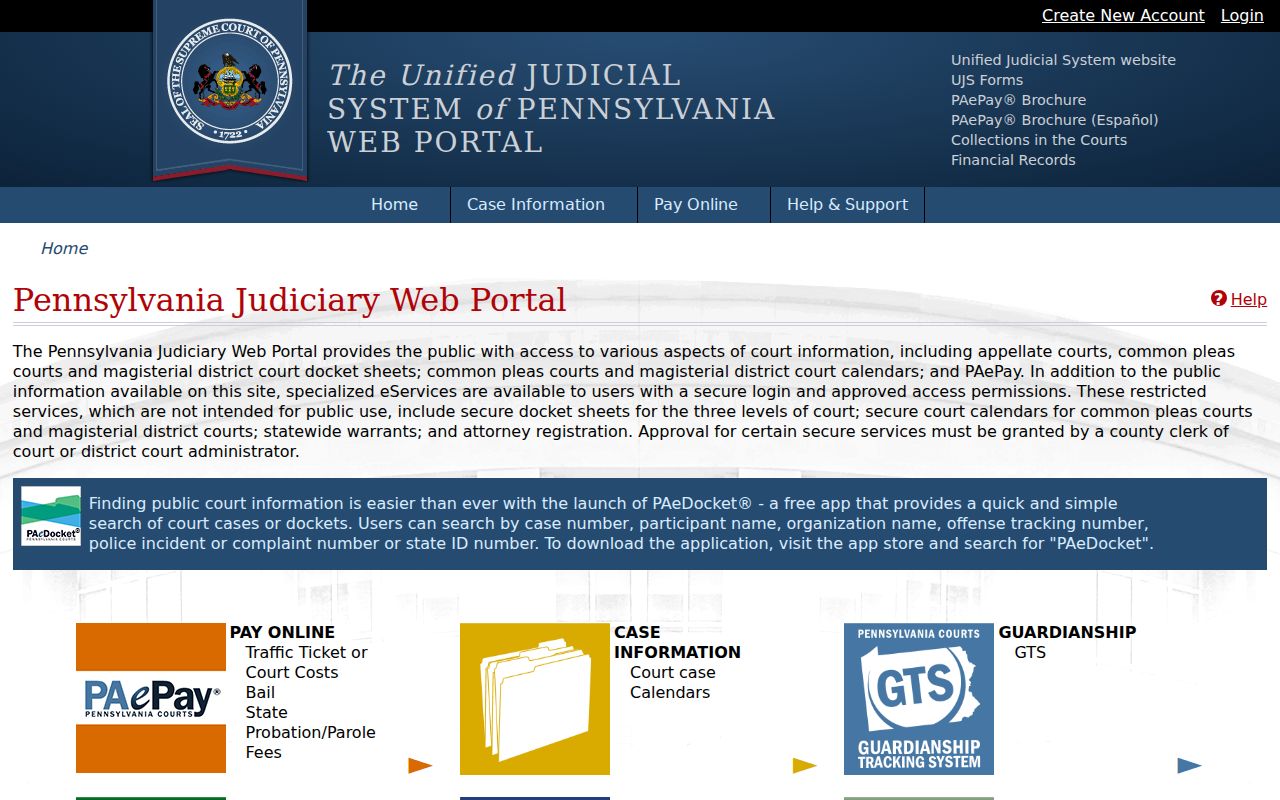
Use the portal to identify the correct docket and party role, then ask the proper Lehigh County division for a copy or certification when the underlying file matters.
Verifying a Lehigh County Resident's Records
A sound resident lookup ties a name to at least two compatible records. The goal is not to collect every result for a surname. It is to check whether the name, place, time, and record role describe the same person. Keep an evidence note with the source, date viewed, exact spelling, and the fact the record actually supports.
- Start with a precise name variant and an address, time period, parcel, entity, or court clue. A name alone is too weak where multiple people share it.
- When an address is known, search PropertySearch and record the displayed owner spelling, PIN or PAR, situs line, and separate mailing line. Do not convert the mailing line into an occupancy finding.
- Use an instrument number or legal-description clue to reach the Recorder's route. Read the deed roles and date before treating an index entry as a move or ownership conclusion.
- Use UJS only to corroborate a plausible identity. Compare party spelling, filing date, case category, and associated facts with the parcel or document trail.
- For an older life event, test the date against the Archives threshold, then pair an archival result with an obituary, probate docket, or recorded transfer rather than guessing relationships.
- Docket
- A court's running record of a case, including its number, parties, filings, and events. It is not necessarily the complete case file.
- Index versus image
- An index points to a record through names, dates, or identifiers. An image is the underlying scanned document and may reveal context the index does not show.
- Certified copy
- A copy issued and attested by the custodian for an official purpose. It is different from a public index entry or ordinary screen print.
Lehigh County Voter Lookup Limits
Pennsylvania's status tool asks for first name, last name, date of birth, county, and ZIP code. It is an individual identity-match and status route, not a universal name search. For a Lehigh County registration question, the County Voter Registration Office is the local alternative. A status result does not identify everyone in a household, prove property ownership, or reveal a ballot choice.
Street, Walking, Public Information, and Full Voter Export lists are separate regulated products. The state request form requires identification, a signature, a selected list type, and an affirmation limiting use and barring internet publication. That division matters: a no-match on an individual form does not authorize a broad search for a neighbor or family member.
The official Pennsylvania voter-status page directs a registrant to the identity-match service and county contact route.
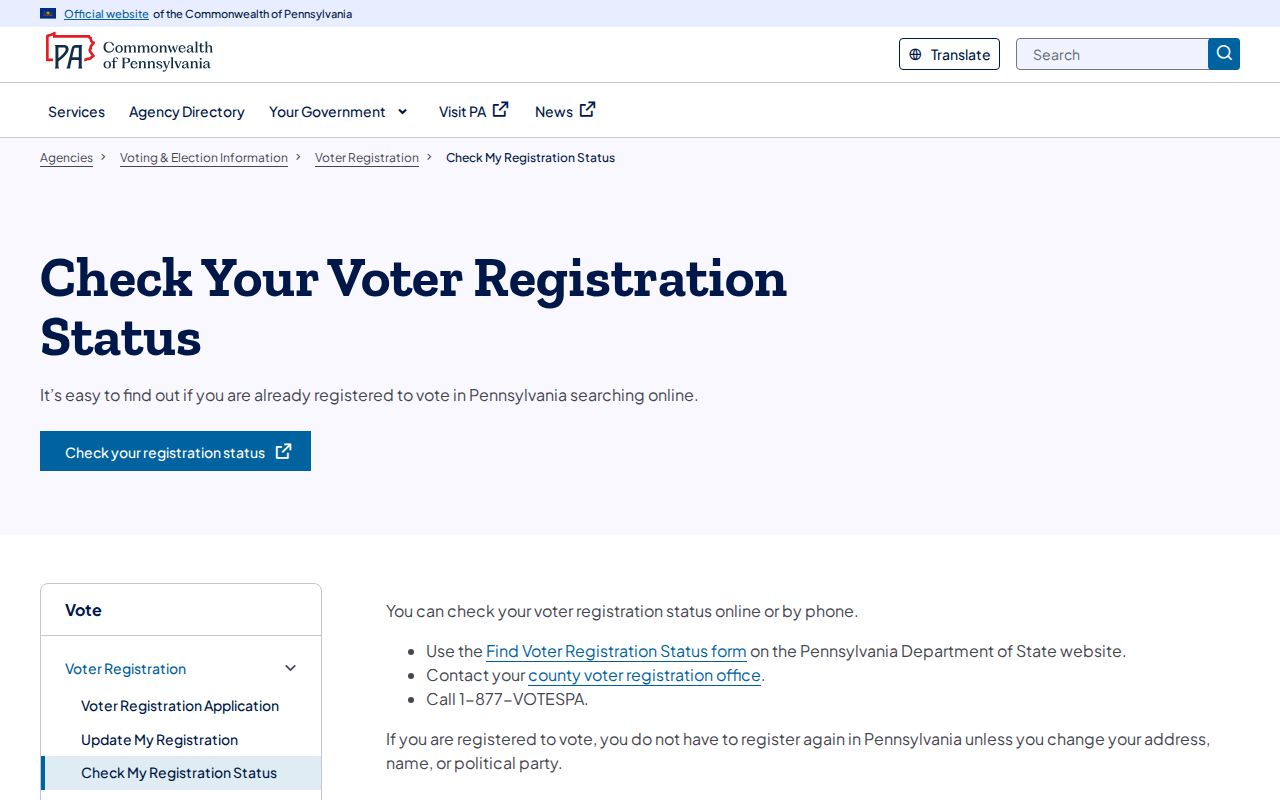
The screenshot is a reminder to use the individual-status channel for its intended purpose, while treating voter-list requests as a separately controlled process.
Lehigh County Vital Lookup Dates
State vital-record registration begins in 1906. Pennsylvania makes birth records public 105 years after birth and death records public 50 years after death. The State Archives holds the historical route once those thresholds are reached, but current certified certificates remain eligibility-based. Marriage licenses are held by the county that issued them, and a Lehigh divorce file belongs with the county Civil Division where the action was filed.
For a qualifying Archives request, a noncertified copy is listed at $5 when the requester provides the person's name, date, and certificate number. That archive service should not be treated as a public directory of recent certificates. A qualified historical result is a lead to cite by certificate number and record date, not permission to publish more than the custodian provides.
The Pennsylvania Archives request page illustrates the date-qualified, noncertified copy route.
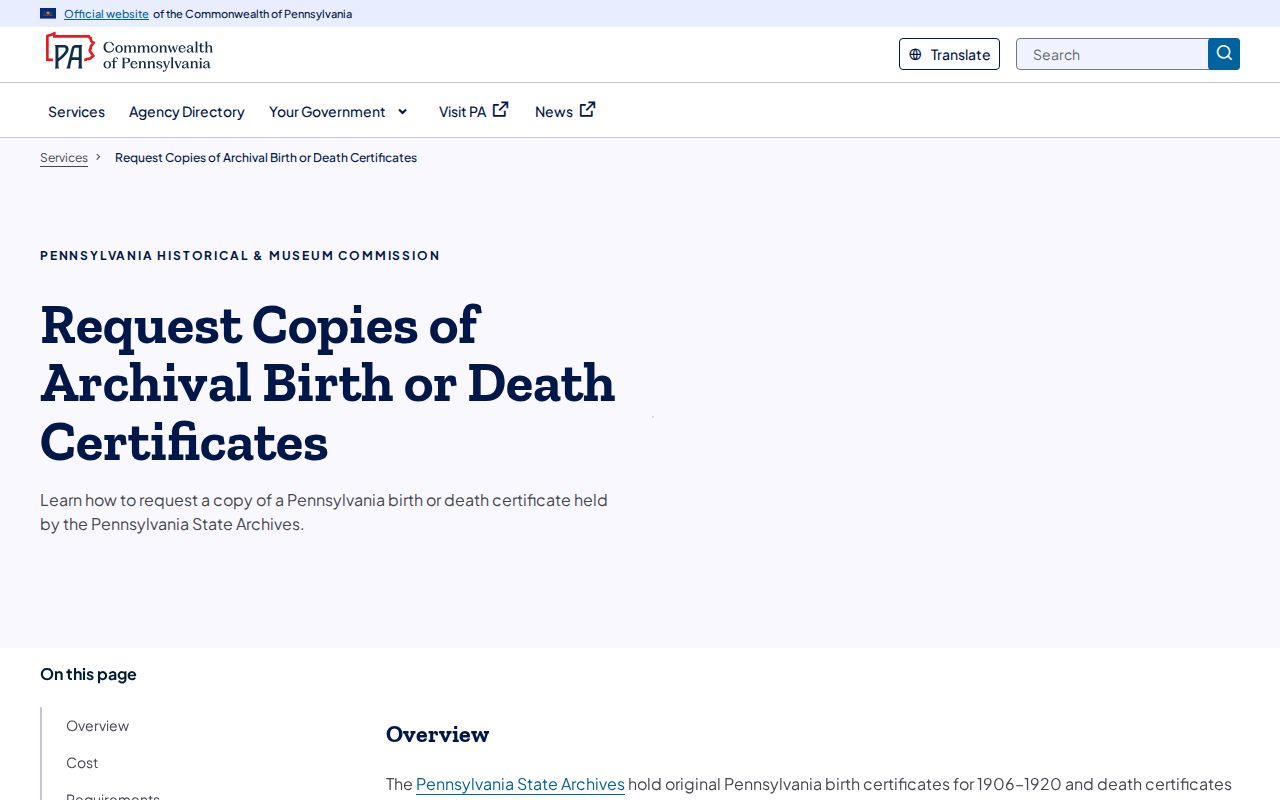
For a newer certificate, contact the Department of Health Division of Vital Records and follow its eligibility and application requirements instead.
Lehigh County Specialty Lookup Routes
For an estate or heir question, the Register of Wills and Orphans' Court route is more precise than a general court-name search. County materials distinguish will and inheritance-tax indexes from general public dockets. An index may identify a decedent, fiduciary, or file lead, but the underlying file, not a surname alone, is needed before making a relationship claim.
For adoption questions, Pennsylvania's adoptee process and the Pennsylvania Adoption Information Registry, or PAIR, are the official channels. Adoption and sealed court records are not general lookup material. A business search also has a narrow purpose: the Department of State searches by entity name or entity number, not by owner or officer name or business address. PALS verifies a professional credential and any displayed discipline, not a licensee's residence.
Note: Match the record to the question, then retain the record number and retrieval date for the next custodian contact.
Legal Limits on a Resident Lookup
Pennsylvania's Right-to-Know Law offers a written records-request channel, not a way to convert protected data into public data. Send a correction request to the office that keeps the property, court, voter, vital, business, or license record in question. A request should identify the record precisely and can result in redactions or lawful withholding.
The Address Confidentiality Program gives eligible participants a substitute address for listed government records. A missing, sealed, redacted, or substitute-address result can be a safety protection. It is not a reason to search around the protection through another source.
Lawful use. Use a Lehigh County resident lookup only for lawful personal research. Do not use records to stalk, harass, intimidate, or expose a protected person's actual address.